

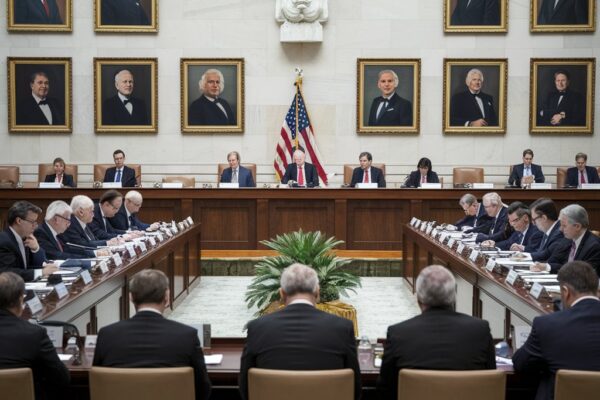


The global financial ecosystem continually tracks the actions of the Federal Open Market Committee (FOMC) as the definitive barometer for economic liquidity and asset valuations. As financial markets navigate through mid-2026, attention focuses heavily on the upcoming central bank gathering. Market analysts, institutional investors, and retail traders alike are evaluating incoming macroeconomic data to forecast the central bank’s definitive policy path.
With shifting dynamics involving energy commodities, labor market resilience, and geopolitical tensions, the upcoming policy announcement carries immense weight. This comprehensive analysis explores the most probable outcomes for the policy decision, evaluating the delicate balance between sticky inflationary pressures and economic expansion under leadership guidance.
The Macroeconomic Backdrop of Mid-2026
To accurately evaluate the probable trajectory of the central bank’s benchmark rate, one must examine the broader economic landscape. Policymakers do not operate in a vacuum; they react to a constantly evolving matrix of growth indicators, employment metrics, and price stability measures.
Core Economic Indicators Shaping the Decision
A. Labor Market Resilience: Recent reports highlight that U.S. job creation continues to match labor force expansion trends, keeping the unemployment rate anchored at healthy historical lows while nominal wages register steady growth. This ongoing resilience removes immediate pressure on the committee to introduce aggressive easing measures.
B. Resurgent Energy Pressures: Fluctuations in international energy sectors, compounded by renewed Middle East friction, have pushed crude oil benchmarks higher. Average retail fuel costs have experienced upward revisions, reviving concerns regarding imported inflation and transportation expenses.
C. Structural Price Pressures: Beyond standard consumer metrics, structural factors such as massive enterprise investments in artificial intelligence infrastructure, data center buildouts, and newly implemented tariff policies continue to introduce upside risks to baseline inflation forecasts.
D. The Core Inflation Trajectory: Although headline consumer price readings have shown occasional signs of cooling, core metrics measured by the Personal Consumption Expenditures (PCE) index remain noticeably above the central bank’s institutional 2% target objective.
The Baseline Consensus: Pausing at the Crossroads
The prevailing market consensus points toward a steady approach by the committee. Data derived from the CME FedWatch Tool indicates that a significant majority of market participants expect the federal funds rate target range to remain untouched at 3.50% to 3.75%.
Why a Policy Pause Remains the Leading Scenario
A. Consecutive Stability: Opting to hold the benchmark range steady would mark the fifth consecutive meeting where policymakers have maintained a defensive posture, allowing past tightening cycles to fully filter through the broader economy.
B. Evaluating Past Adjustments: Central bank leadership frequently emphasizes that monetary policy operates with long, variable lags. Maintaining current parameters gives officials sufficient time to assess whether previous policy restrictions are adequately subduing aggregate demand.
C. Balancing Dual Mandates: With employment metrics performing steadily, officials possess the luxury of patience regarding price stability, choosing to hold rates steady rather than risking premature easing that could re-ignite inflationary spikes.
Emerging Hawkish Undercurrents and Alternative Scenarios

Although a policy pause is widely anticipated, financial futures markets have gradually priced in a non-trivial probability of a tighter monetary stance later in the year. Several governing officials have publicly noted that the committee must remain vigilant against complacency.
Factors Keeping Rate Hikes on the Table
A. The Risk of Stickiness: If core indices refuse to converge smoothly toward the 2% objective, committee members favoring structural tightening may gain stronger arguments for implementing additional quarter-point increments before year-end.
B. Shifting Market Probabilities: Bond and futures market indicators show that a notable percentage of investors anticipate potential policy firming by autumn or winter if energy shocks prove durable rather than transitory.
C. Institutional Communication Shifts: Under the guidance of Federal Reserve Chair Kevin Warsh, the institution has signaled a strategic shift toward reduced forward guidance, placing greater emphasis on incoming economic data releases rather than fixed multi-meeting projections. Consequently, market participants must monitor real-time economic prints more closely than ever.
Implications for Global Financial Markets

A steady rate decision coupled with a cautious, data-dependent stance generates distinct ripple effects across multiple asset classes.
- Equities and Growth Sectors: Risk assets generally welcome stability, but hawkish commentary regarding potential future tightening can trigger short-term equity pullbacks, particularly in high-valuation technology and AI-infrastructure segments.
- Foreign Exchange and the U.S. Dollar: A cautious stance combined with sticky domestic inflation tends to support the greenback against major foreign currencies, as the relative yield advantage of dollar-denominated assets remains intact.
- Precious Metals and Commodities: Non-yielding assets like gold face a complex environment where persistent economic resilience and the threat of higher-for-longer borrowing costs challenge upside momentum, even as institutional accumulation acts as a structural price floor.
Conclusion
The consensus outcome points heavily toward a steady maintenance of interest rates as policymakers weigh cooling consumer metrics against fresh energy and structural price shocks. While market participants should not expect dramatic immediate alterations to the benchmark range, the accompanying commentary and press conference statements will serve as critical compass points for the remainder of the financial year. Staying adaptable and closely monitoring incoming macroeconomic releases will remain essential strategies for navigating central bank volatility.